

Our technology
HA Nanogel.
A carrier built from hyaluronic acid.
1 · Why a carrier
The best part of the leaf doesn’t like water.
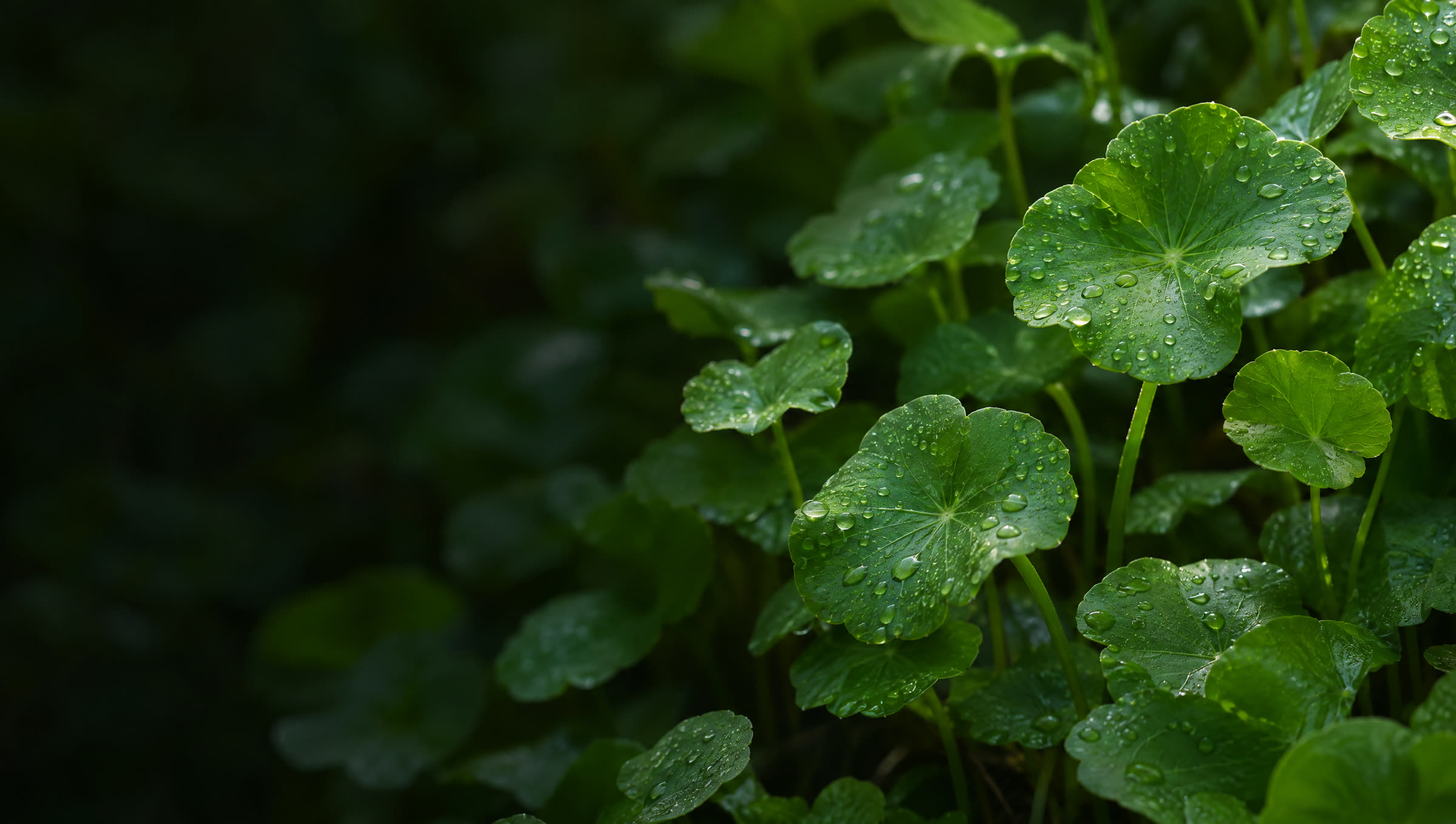
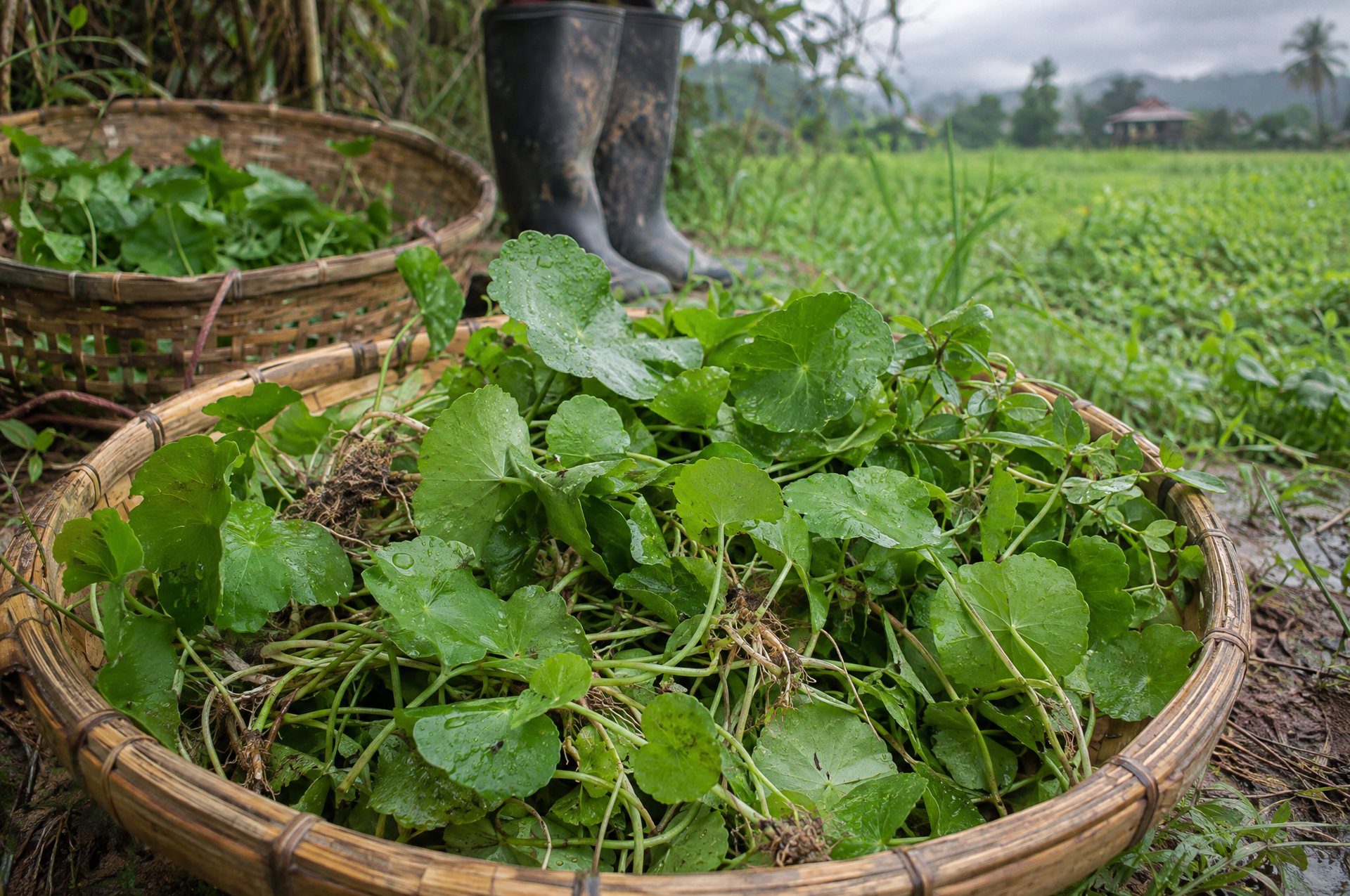
Centella’s skin-calming compounds come as a family of four. Two dissolve in water fairly well. The other two, asiatic acid and madecassic acid, barely dissolve at all.
A cream is mostly water. Whatever can’t dissolve in it clumps, settles or breaks down, and a compound that has dropped out of the cream isn’t doing anything for your skin. That is the problem the nanogel was built to solve.
2 · What it is
Hyaluronic acid, taught a new trick.
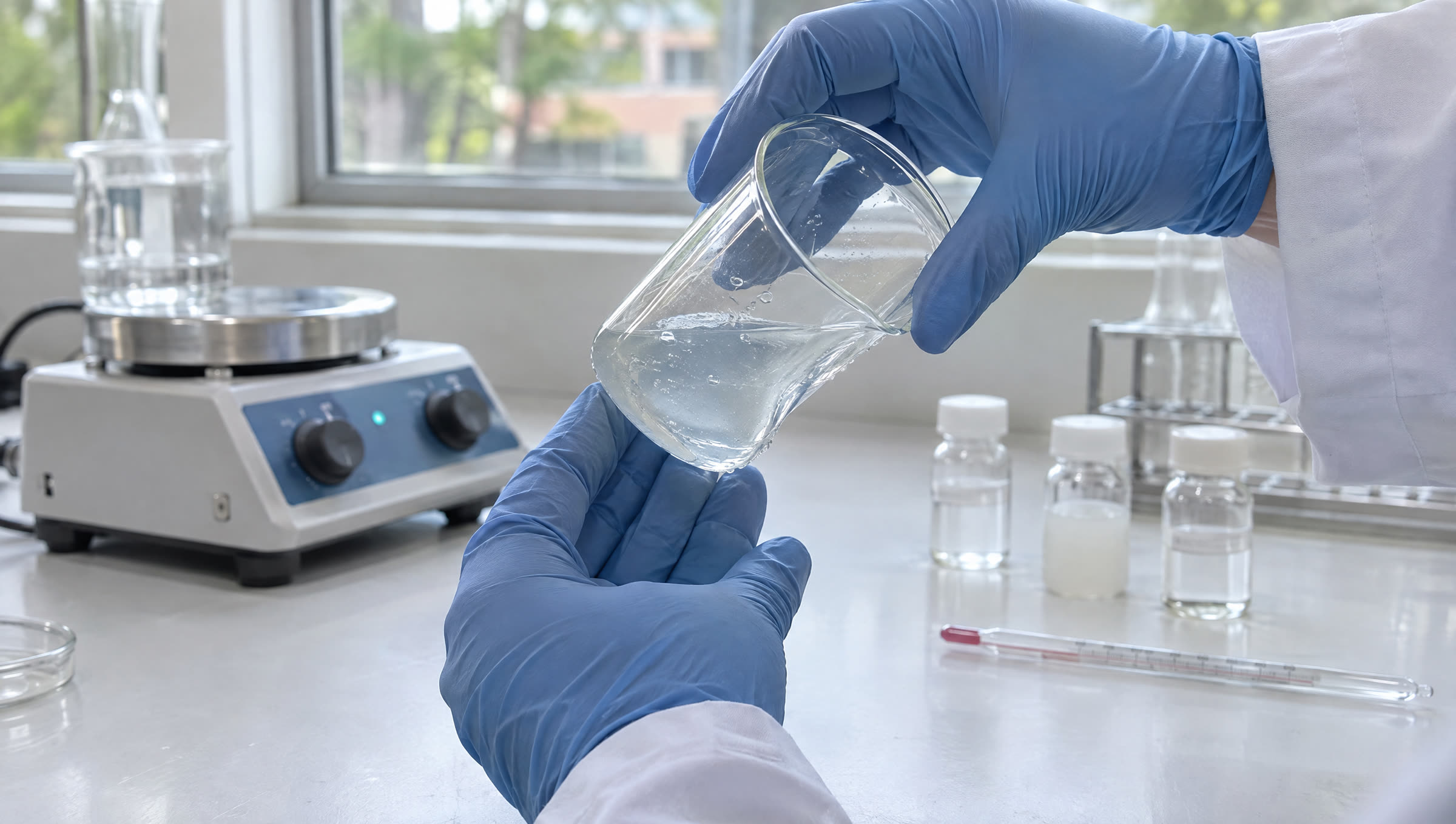
You know hyaluronic acid from serums. It is the molecule skin already uses to hold water. Our scientists took a chain of it and attached short side-branches of a second polymer, one that changes its behaviour with warmth.
Put the result in water and it builds itself. The branches fold inwards and the hyaluronic acid stays on the outside, forming soft particles a few hundred nanometres across. That is about a hundred times finer than a hair, and far too small to see or feel.
On an ingredient list it appears as Hyaluronic Acid/Polyisopropylacrylamide Copolymer. We call it HA Nanogel.
3 · How it holds the leaf
A water-loving outside. A pocket inside.
The inside of each particle is a sheltered pocket, the kind of place a water-shy compound wants to be. The outside is hyaluronic acid, which is happy in water. So the Centella sits inside, the particle sits in the cream, and nothing drops out.
In the published tests, the nanogel held 250 to 400 times more asiatic acid in water than water could hold alone, and it captured more than 86% of what was added.
It responds at the temperature of your skin.
The second polymer is the warmth-sensitive part. On its own it changes at 32 °C. Joined to hyaluronic acid, the change moves up to 34 to 35 °C.
That is the temperature of the surface of your skin, and well above a tube sitting on a bathroom shelf. The gel stays as it is in the tube and responds when it meets you.
Published, with numbers.
The nanogel was described in a peer-reviewed journal in 2021, using asiatic acid, the hardest of Centella’s compounds to dissolve.
| Question | Result |
|---|---|
| How much more does it hold? | 250 to 400 times more asiatic acid in water than water alone |
| How much does it capture? | 86% to 100% of the asiatic acid added |
| How small is it? | Particles of roughly 350 to 800 nanometres |
| When does it respond? | At 34 to 35 °C as it warms |
| Does it keep? | Stable over 180 days at fridge and room temperature |
Then came the test that matters most. The nanogel went into a cream with 0.20% standardised Centella extract, and that cream went into a clinical study against a 1% hydrocortisone cream. See how the study worked
6 · Beyond Centella
One carrier. More plants to come.
Centella isn’t the only plant with this problem. Many of the most interesting compounds in Thai herbs are water-shy in the same way. The same research group has published the nanogel carrying curcumin, from turmeric.
That is where our profit goes: into finding the next herb the nanogel can carry, and the next group of farmers who grow it. Read our story
Nanogel questions
Is it the same hyaluronic acid as in my serum?
It’s the same molecule. Here it does two jobs: it holds water, and it forms the outside of the particles that carry the Centella.
What does “nano” mean here?
Only that the particles are small: a few hundred nanometres, or less than a thousandth of a millimetre. They are soft gel, not hard grains.
Is it in all three creams?
Yes. Clinical Repair, Pediatric Calm and Daily Sensitive all carry their Centella in HA Nanogel.
Will I feel it?
No. The particles are far too small to feel. The cream goes on like any light, water-based cream.
What is it called on the label?
Hyaluronic Acid/Polyisopropylacrylamide Copolymer. Its listed job in a cosmetic is to hold water. See every ingredient
References
- The nanogel and asiatic acid: solubility, stability and compatibility. Polymers, 2021. doi.org/10.3390/polym13234071
- The same hyaluronic acid nanogel as a carrier for a second plant compound. Polymers, 2021. doi.org/10.3390/polym13020194
- The ingredient entry for the carrier, Hyaluronic Acid/Polyisopropylacrylamide Copolymer. COSMILE Europe. cosmileeurope.eu/inci/detail/29142/hyaluronic-acid-polyisopropylacrylamide-copolymer/
The nanogel is in every tube.
Shop the creams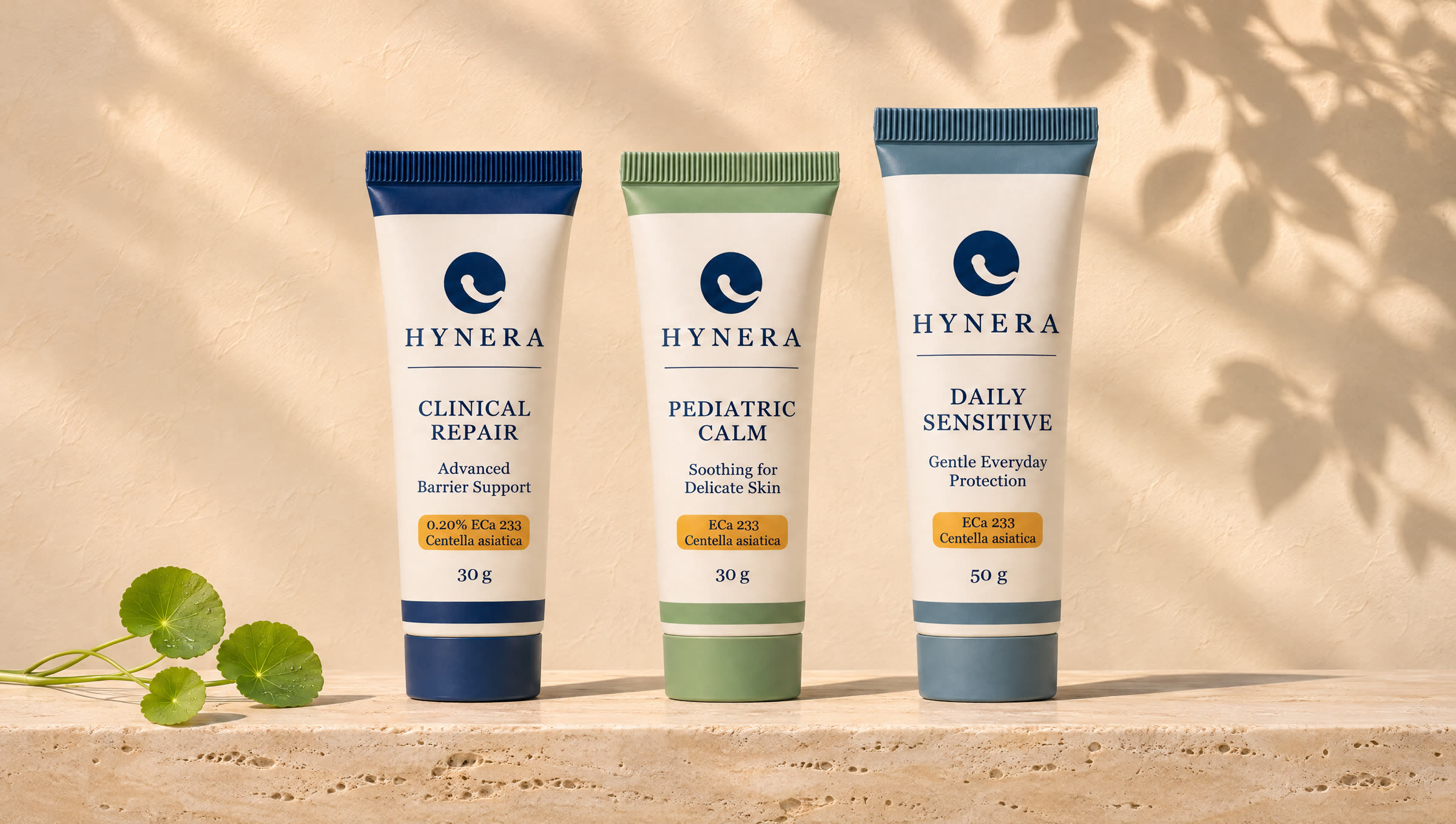
First dibs on new tubes.
Launches, restocks and the odd skin tip. We don’t write often. We’re sensitive too.