


Science
The science
behind the tube.
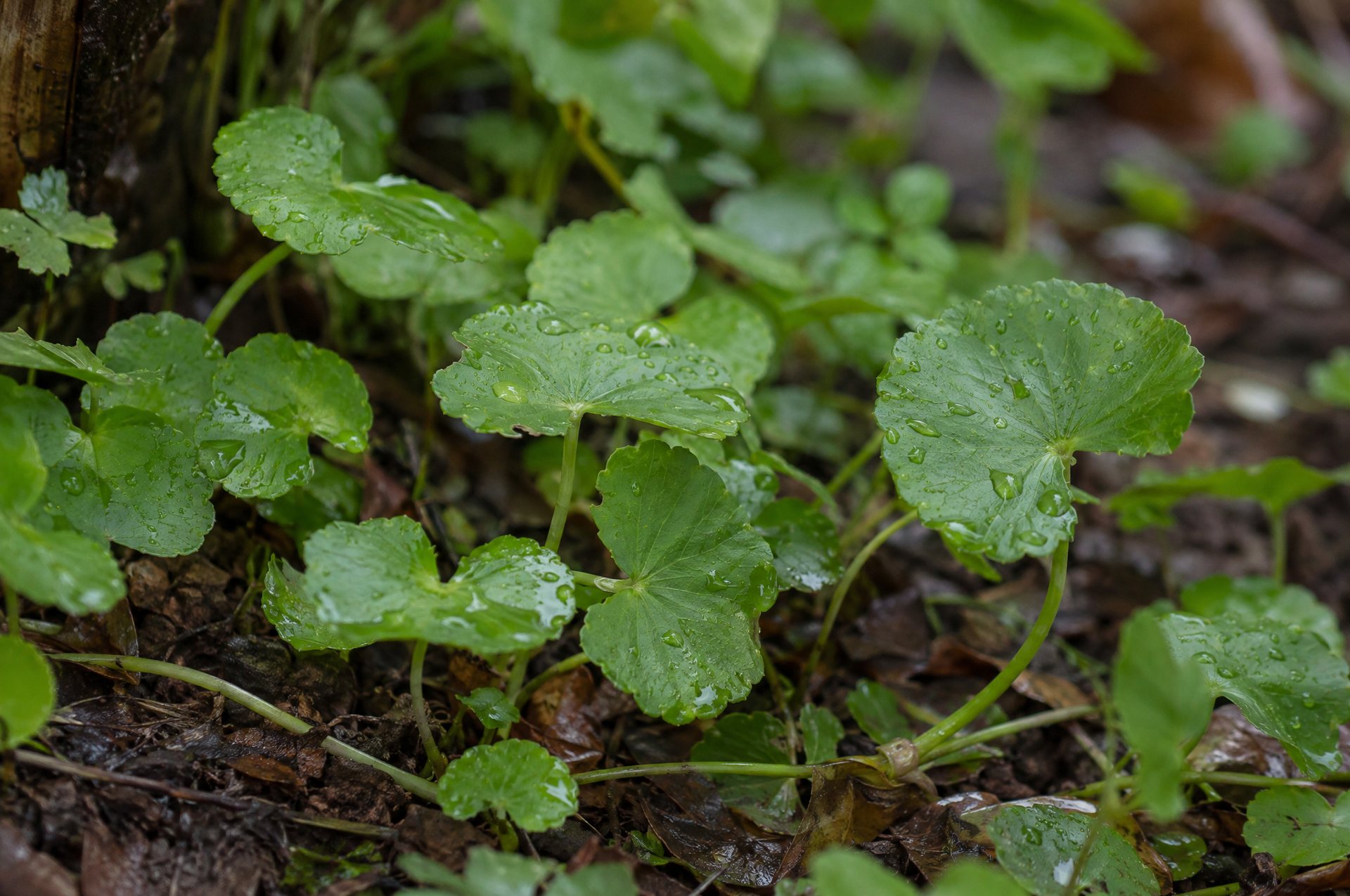
1 · The leaf
A small leaf that skin care keeps coming back to.
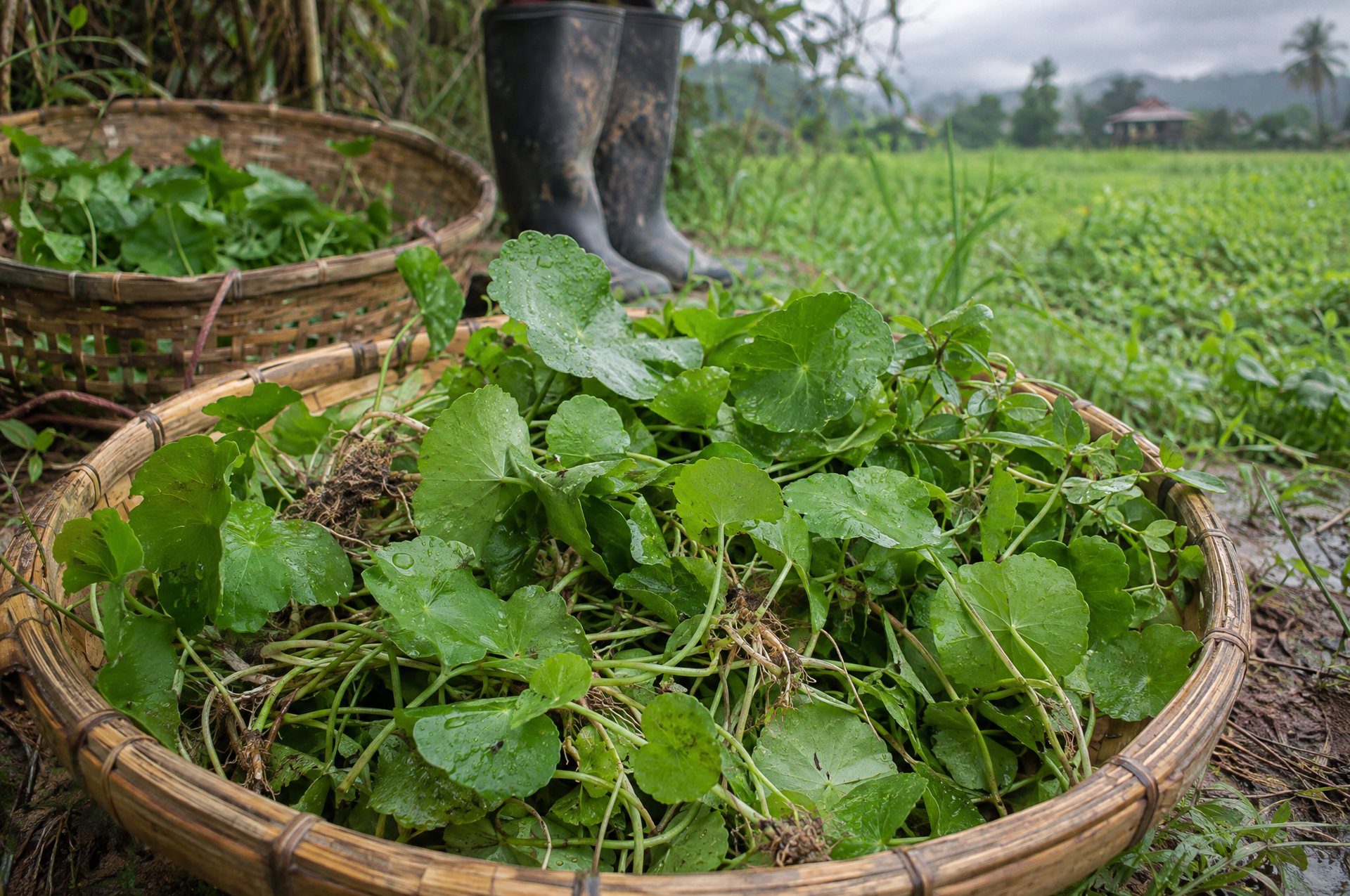
Centella asiatica is a low, creeping plant with round, scalloped leaves. It likes wet ground and grows across tropical Asia. Across Asia, people eat it, drink it and put it on their skin. When a cream says “cica”, this is the plant it means.
What matters for skin is a family of four compounds. Two are the forms the plant stores, and two are what those become.
| Compound | What it is | In water |
|---|---|---|
| Madecassoside | The main stored form, with sugars attached | Dissolves fairly well |
| Asiaticoside | The second stored form, with sugars attached | Dissolves fairly well |
| Madecassic acid | Madecassoside without its sugars | Barely dissolves |
| Asiatic acid | Asiaticoside without its sugars | Barely dissolves |
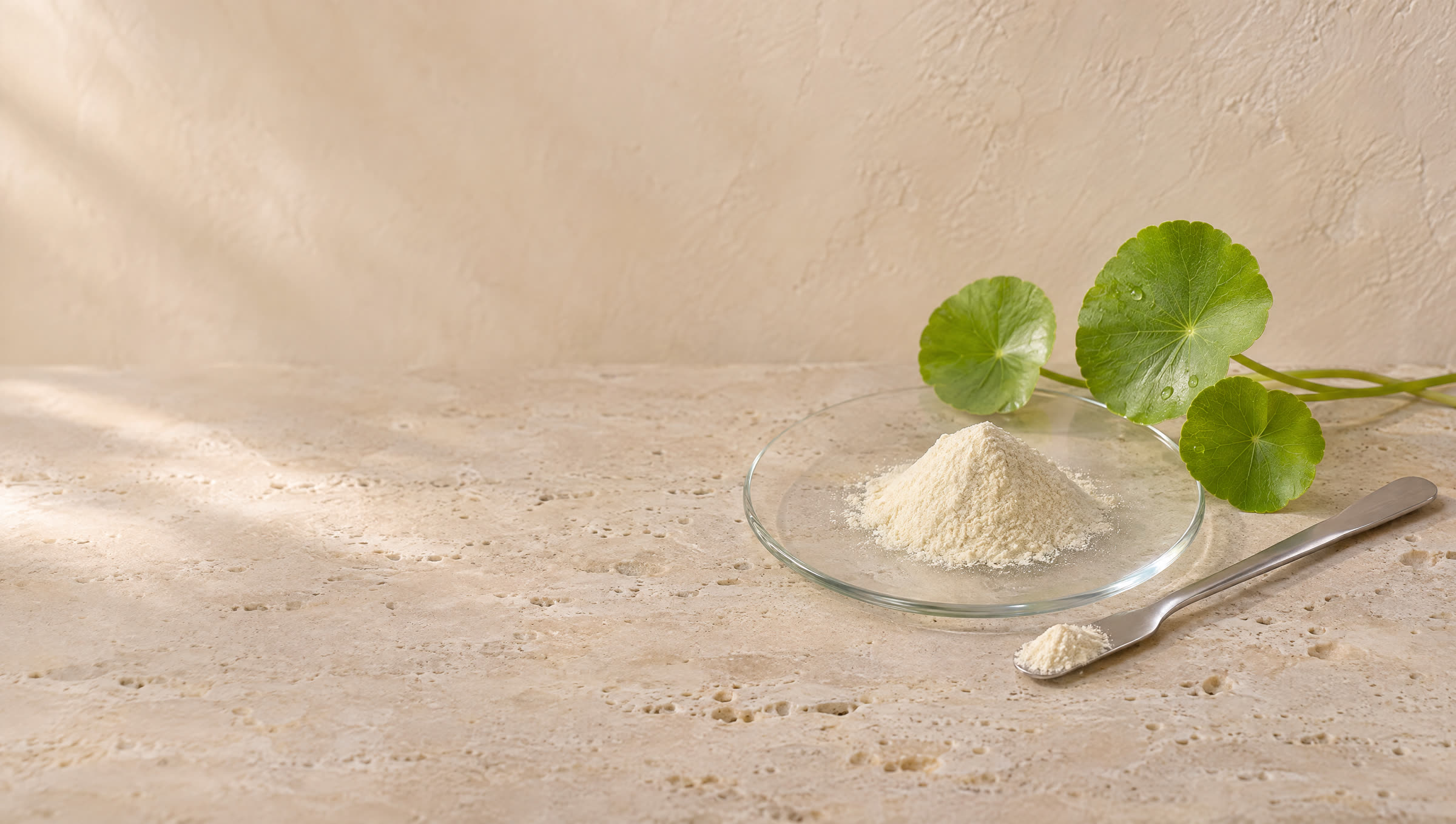
2 · The extract
Standardised Centella: the same leaf, every time.
A plant isn’t a factory. The amount of each compound in a Centella leaf changes with the field, the season and the variety. Two creams with “Centella extract” on the label can hold very different things.
Ours is a medical-grade, standardised extract, developed in Thailand to fix that. More than 80% of it is the two stored compounds, held at a fixed ratio of about 1.5 parts madecassoside to 1 part asiaticoside. Every batch is tested against those numbers before it is used, the way a medicine is. That is why the tube you buy next year works like the one you buy today.
It is also one of the better-studied Centella extracts. Researchers have published on how the body handles it, on its safety in healthy volunteers, and on a 0.05% gel that was compared with a placebo gel on 30 faces after a laser procedure, where the extract side showed less redness.
Clinical Repair uses it at 0.20%, four times that strength.
3 · The carrier
A nanogel made from hyaluronic acid.
Getting Centella into a cream is the hard part. Its compounds don’t all dissolve well, and what doesn’t dissolve can’t do much. So the Centella in our creams travels inside a nanogel.
The nanogel is made of soft particles a few hundred nanometres across, more than a hundred times thinner than a hair. Each one is built from hyaluronic acid, the molecule your skin already uses to hold water, joined to a polymer that responds to warmth. In water the particles assemble themselves.
The scientists who built it published the work in 2021. With asiatic acid, the hardest of the four compounds to dissolve, the nanogel held 250 to 400 times more of it in water than water could alone, captured more than 86% of what was added, and stayed stable for 180 days.
The gel is tuned to skin. In the published measurements it shifts at 34 to 35 °C, which is the temperature of the skin’s surface, and not at the temperature of a tube on a shelf. On an ingredient list the carrier appears as Hyaluronic Acid/Polyisopropylacrylamide Copolymer, and its listed job is to hold water. More on the nanogel
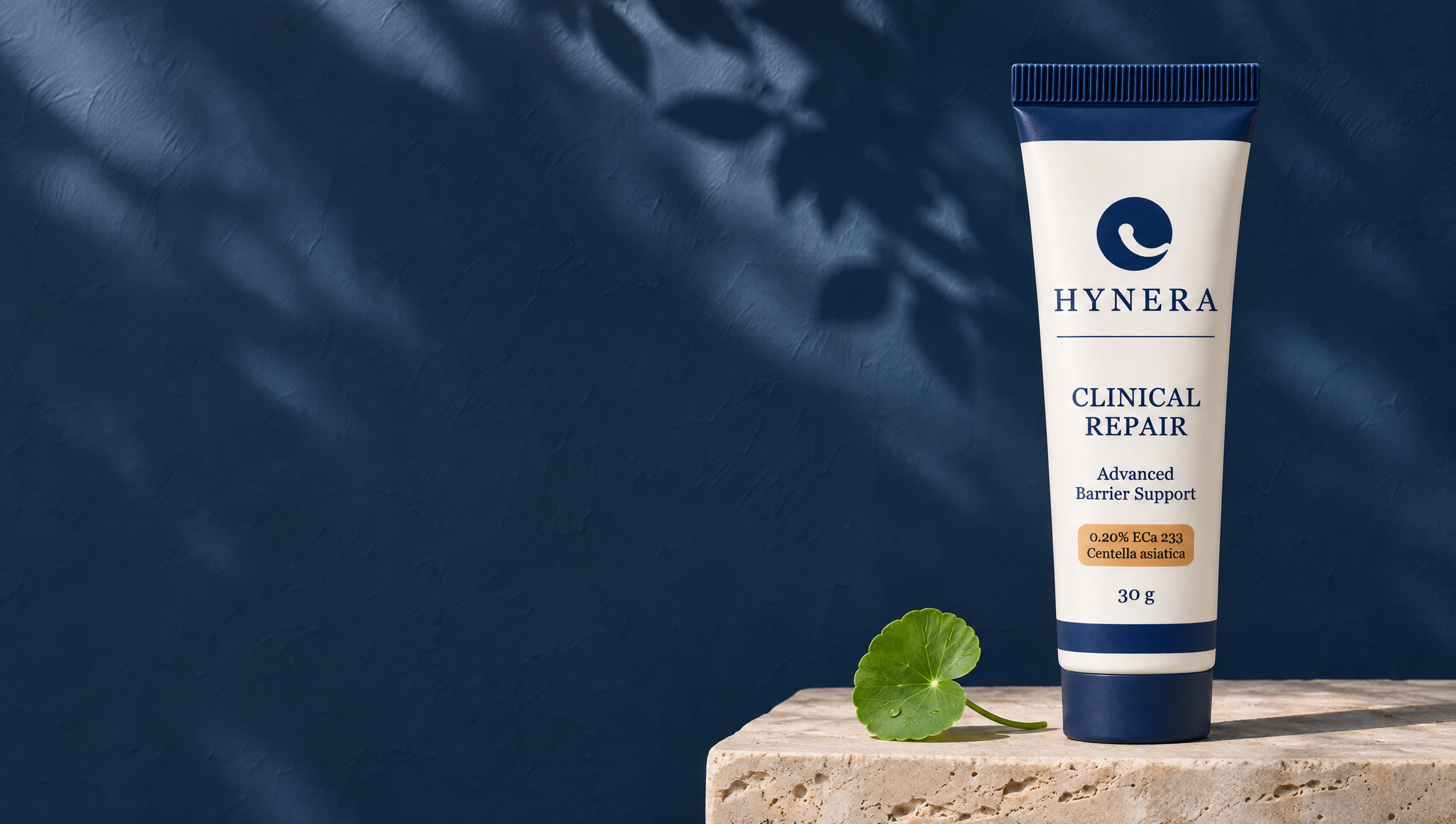
4 · The study
No less effective than 1% hydrocortisone.
Clinical Repair was tested head to head with a 1% hydrocortisone cream in a randomised clinical study. On redness, itch, hydration and water loss, it was no less effective on all four.
- 4 of 4measures, no less effective
- 30adults in the study
- 6 weeksof twice-daily use
How it worked
How we tested Clinical Repair.
Before there was a brand, there was a study. 30 adults joined and 29 finished. Each used the 0.20% Centella cream twice a day for six weeks on one side of the body.
Dermatology researchers saw every person five times and measured the skin with instruments each time. By week six, redness was down on the side that used the cream.
| What was measured | How |
|---|---|
| Redness | A probe that reads skin colour, so the number doesn’t depend on anyone’s eye |
| Water loss | A probe that reads how much water escapes through the skin |
| Hydration | A probe that reads how much water the surface of the skin holds |
| Skin pH | A probe that reads the acidity of the skin’s surface |
5 · How it’s made
From a wet field to a small tube.
- Centella is grown and cut by farmers in Thailand.
- The leaf is extracted, standardised and batch-tested.
- The extract is loaded into our HA Nanogel.
- The nanogel goes into a light, steroid-free cream.
THB 100 from every tube goes back to the farmers at step one. Read why
Science questions
What does “standardised” mean?
It means the extract is made to a recipe with numbers in it. Ours has to be more than 80% Centella’s two main compounds, at a fixed ratio, and every batch is tested before it goes near a cream. A plain “Centella extract” makes no such promise.
Why does Centella need a carrier?
Because some of its compounds barely dissolve in water, and most creams are mostly water. The nanogel holds them in a form a water-based cream can carry.
Why 0.20%?
Because that is the strength we tested. Clinical Repair is the cream from the six-week study, unchanged.
Is hyaluronic acid the same thing as in my serum?
It’s the same molecule. Here it does two jobs: it holds water, and it forms the outside of the particles that carry the Centella.
Were the other two creams in the study?
No. The study tested Clinical Repair. Pediatric Calm and Daily Sensitive use the same extract and the same carrier in gentler, everyday creams.
References
- The nanogel and asiatic acid: solubility, stability and compatibility. Polymers, 2021. doi.org/10.3390/polym13234071
- The same hyaluronic acid nanogel as a carrier for a second plant compound. Polymers, 2021. doi.org/10.3390/polym13020194
- The extract as capsules in healthy volunteers: safety and how the body handles it. Planta Medica, 2019. doi.org/10.1055/a-0835-6671
- A 0.05% gel of the extract against a placebo gel after laser resurfacing, split-face. Journal of Alternative and Complementary Medicine, 2020. doi.org/10.1089/acm.2019.0325
- The ingredient entry for the carrier, Hyaluronic Acid/Polyisopropylacrylamide Copolymer. COSMILE Europe. cosmileeurope.eu/inci/detail/29142/hyaluronic-acid-polyisopropylacrylamide-copolymer/
First dibs on new tubes.
Launches, restocks and the odd skin tip. We don’t write often. We’re sensitive too.